Two Gravies, One Table: A Realistic Plan for a Filipino-American Thanksgiving
Every November, the group chat heats up with a question that sounds simple and isn't: turkey or Filipino food?
The honest answer at most Filipino-American tables is both — but not by cooking two complete menus. That's the trap. Two full spreads means two gravies nobody finishes, a stove with every burner occupied, and a host who finally sits down when everyone else is reaching for dessert. What actually works is one menu with two accents, built around the oven you really have and the number of hands you can actually recruit.
Here's the plan we'd run in 2026, whether you're hosting twelve relatives or carrying a dish to a Friendsgiving across town.
Start with the headcount, not the menu
Write down how many people are coming and how many are children under ten. That number decides everything else. A 14- to 16-pound bird feeds roughly ten adults with leftovers; if you're also serving pancit and lumpia, you can drop to a 12-pound turkey and nobody will notice. Rice-based dishes are filling in a way mashed potatoes aren't, and a plate with garlic rice, a slice of turkey, and a scoop of pancit is genuinely a full meal.
Rule of thumb: one turkey, one noodle dish, one fried item, one vegetable, and rice. That's five things. Everything past that should be a guest's contribution, not your obligation.
The oven belongs to the turkey. The stove belongs to you.
A 14-pound bird at 325°F takes about three and a half hours. That's your fixed point. Everything else in the Filipino column should either be made ahead or cooked on the stovetop, because the oven is booked from mid-morning until the bird rests.
- Pancit is a 30-minute stovetop dish and it's better the day it's made, so it goes last — while the turkey rests.
- Lumpia can be rolled and frozen two days out, then fried in batches in a deep pot on the stove. Twenty minutes per batch, and the oil doesn't care what else is happening.
- Garlic rice comes from the rice cooker and gets its toasted garlic and oil at the very end.
- A vegetable — green beans with garlic, or ginisang sitaw — takes one burner and eight minutes.
Notice what's absent: no second casserole fighting for rack space, no reheated tray of something that peaked an hour ago.
Pick the Filipino dishes that hold up
Thanksgiving is a marathon with a long middle stretch where nothing gets served. Dishes with vinegar, soy, or a braise behind them get better with time — adobo, bistek, mechado, chicken with potatoes and carrots. If you want a Filipino main alongside the bird, a pot of chicken adobo made the night before and gently reheated is almost zero risk.
What doesn't travel well to a buffet: anything with a crisp shell that needs to stay crisp, fresh lumpia with a soft wrapper, and noodle dishes that sit in sauce. Those are fine for your own kitchen where you control the timing. For a Friendsgiving across town, be strategic.
Which dishes survive a car ride
If you're the guest bringing Filipino food, think like a caterer. Adobo, caldereta, and mechado travel beautifully in a covered pot and taste fine at warm-room temperature for the short window before serving. Frozen lumpia that you fry on arrival — if your host allows it — wins friends. Pancit is risky on a 40-minute drive; it goes soft and clumps.
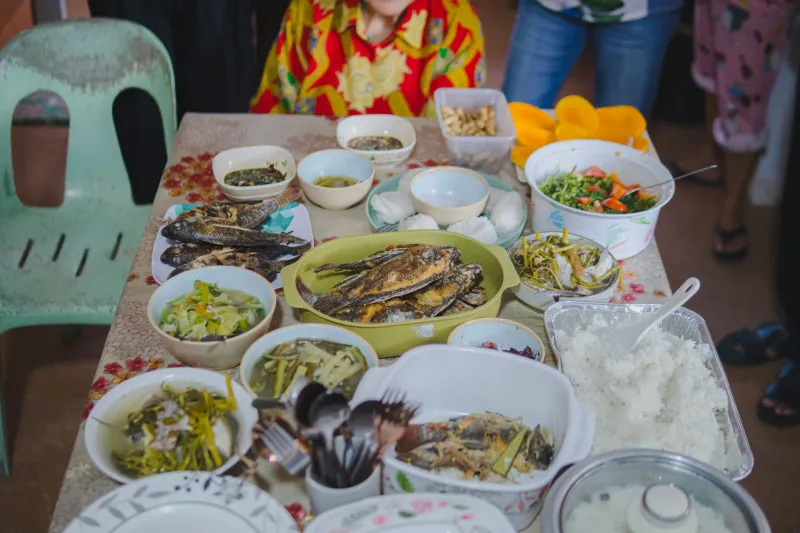
The safest contribution for someone else's house is rice. Bring a rice cooker if you have a spare, or a big foil pan of garlic fried rice that can go into the oven for ten minutes after the turkey comes out. Nobody at a Thanksgiving table has ever complained about extra rice.
The move that makes it one meal instead of two
Here's the small thing that changes everything: put the turkey gravy on the rice.
Not instead of mashed potatoes — alongside. A spoon of gravy over garlic fried rice is a genuinely great bite, and it tells the table that these aren't two menus sharing a room. They're one plate. Do the same with cranberry sauce and a piece of lechon kawali if you're feeling ambitious, or with the pancit's calamansi wedge squeezed over the dark meat.
Serve the sawsawan in a small bowl next to the gravy boat. Two condiments, equal billing. That's the whole idea in one gesture.
A day-by-day timeline that actually fits
Two days before: Roll and freeze lumpia. Dry-brine the turkey if that's your method. Shop for the produce you'll use in the last 24 hours.
The night before: Make the adobo or braise, cool it, and refrigerate. Chop garlic, onion, and vegetables for pancit and store them in containers. Set the table.
Morning of: Turkey in the oven. While it roasts, cook rice, prep the vegetable, and set out serving dishes. Do not start the pancit.
One hour before: Turkey out to rest. Fry the lumpia. Cook the pancit. Toast garlic for the rice. Warm the braise on a back burner.
Serve: Turkey carved, gravy in a pitcher, pancit in the biggest platter you own, rice in the cooker insert with a serving spoon stuck in it.
The point of the whole exercise
A Thanksgiving table that belongs to both traditions isn't a table with two complete menus stacked on it. It's a table where the gravy and the sawsawan sit close enough to touch, where someone's aunt asks for rice with her turkey, and where the host is sitting down by the time the plates are passed. That's the goal. Everything else is just logistics.