The One Appliance That Never Gets Put Away
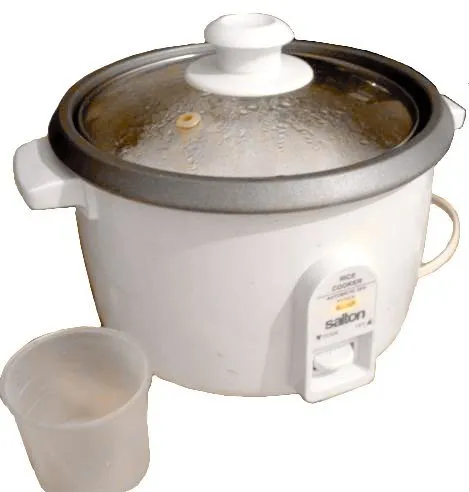
Photo: Taken by User:Aarchiba; detoured by Rama, Public domain, via Wikimedia Commons
Walk into the kitchen of almost any Asian-American home in America and locate the most expensive-looking countertop appliance. Is it the Instant Pot? The air fryer? The stand mixer from a wedding registry a decade ago?
No. It's the rice cooker. And — this is the important part — it is out. Plugged in. On the counter, occupying prime real estate next to the coffee maker, in kitchens where every other appliance lives in a cabinet like a hermit. There's a reason for that, and it's not just that it's heavy to put away.
The Appliance That Never Clocks Out
Every other gadget in the American kitchen has a moment. The Instant Pot had 2017. The air fryer had the pandemic. The rice cooker has every day, forever.
In our house, it runs at least three times daily. Morning rice for the kids' longganisa-and-egg breakfast. Afternoon rice for dinner prep. And then — this is the part that surprises people — it keeps the rice warm, on 'keep warm' mode, until roughly 11 p.m., when my teenager wanders downstairs like a friendly ghost, opens the lid, scoops a bowl, and pads back upstairs. The rice cooker is the only appliance in America with a midnight shift.
My mother-in-law calls it the heartbeat of the kitchen, and once you notice it, you can't un-notice it. The gentle click. The steam escaping the lid. The little light that never fully goes off. It is the appliance equivalent of a porch light left on.
The Second Life Nobody Told You About
If you think a rice cooker only makes rice, you've been underselling the hardest-working machine in your kitchen. Here's what it does in our house and countless others:
Congee, overnight. Rice, water or stock, a thumb of ginger, a splash of fish sauce, set before bed. You wake up to silky rice porridge that costs about 40 cents a serving and cures whatever ails you. Sick kids, hangover Sundays, cold snaps — congee is the answer, and the rice cooker makes it with zero supervision.
Steamed fish in 15 minutes. Lay a fillet on a heatproof plate, splash with soy sauce, ginger, and scallions, set it on a trivet over an inch of water, and hit cook. The rice cooker steams fish more gently than most stovetop setups — no risk of overcooking, no fish smell lingering for days.
Actual cakes. This is not a hack; it's a whole genre. Rice cooker sponge cakes are legendary across Asia for being impossibly moist, because the sealed environment works like a steamer-oven hybrid. Boxed mix, cooked in the rice cooker, comes out better than it has any right to.
Steamed everything else. Dumplings from frozen. Vegetables. Bao. Eggs, hard-cooked, in a steamer basket, coming out perfect every time.
One-pot meals for the lazy and the tired. Rice on the bottom, marinated chicken thigh on top, hit cook. The drips from the chicken season the rice. Dinner. No monitoring, no stirring, no oven heating up the kitchen in July.
Why It Beats the Shiny New Machines
Look, I own an Instant Pot. It's fine. It's also, on any given week, used a third as often as the rice cooker, takes longer to come to pressure than the rice cooker takes to finish an entire cycle, and requires me to read a manual.
The rice cooker's genius is that it asks nothing of you. One button. Rinse, add water to the knuckle line (yes, that's a real technique, and yes, it works), press, walk away. It has no settings to learn because it doesn't need them — a simple thermostat and heating element do all the work, which is also why a $25 machine from 1995 can outlast three Instant Pots.
And there's the deeper point, the one that makes this appliance non-negotiable in a Filipino-American kitchen: it's always ready. Not warming up, not preheating, not waiting for you to decide. Rice is there — breakfast, midnight, whenever. In a culture where food is how we say the things we can't say out loud, the machine that always has something warm waiting is doing emotional labor, not just kitchen labor.
The Verdict
Clear a spot on your counter. Next to the coffee maker, where it belongs. A basic $30 model will serve you for a decade; a fuzzy-logic Zojirushi will serve you for two. Either way, within a month you'll wonder how you ever lived with an appliance that goes back in the cabinet.
The rice cooker doesn't trend. It doesn't need to. It just keeps the light on — and the rice warm — for everyone in the house, at every hour, forever.